
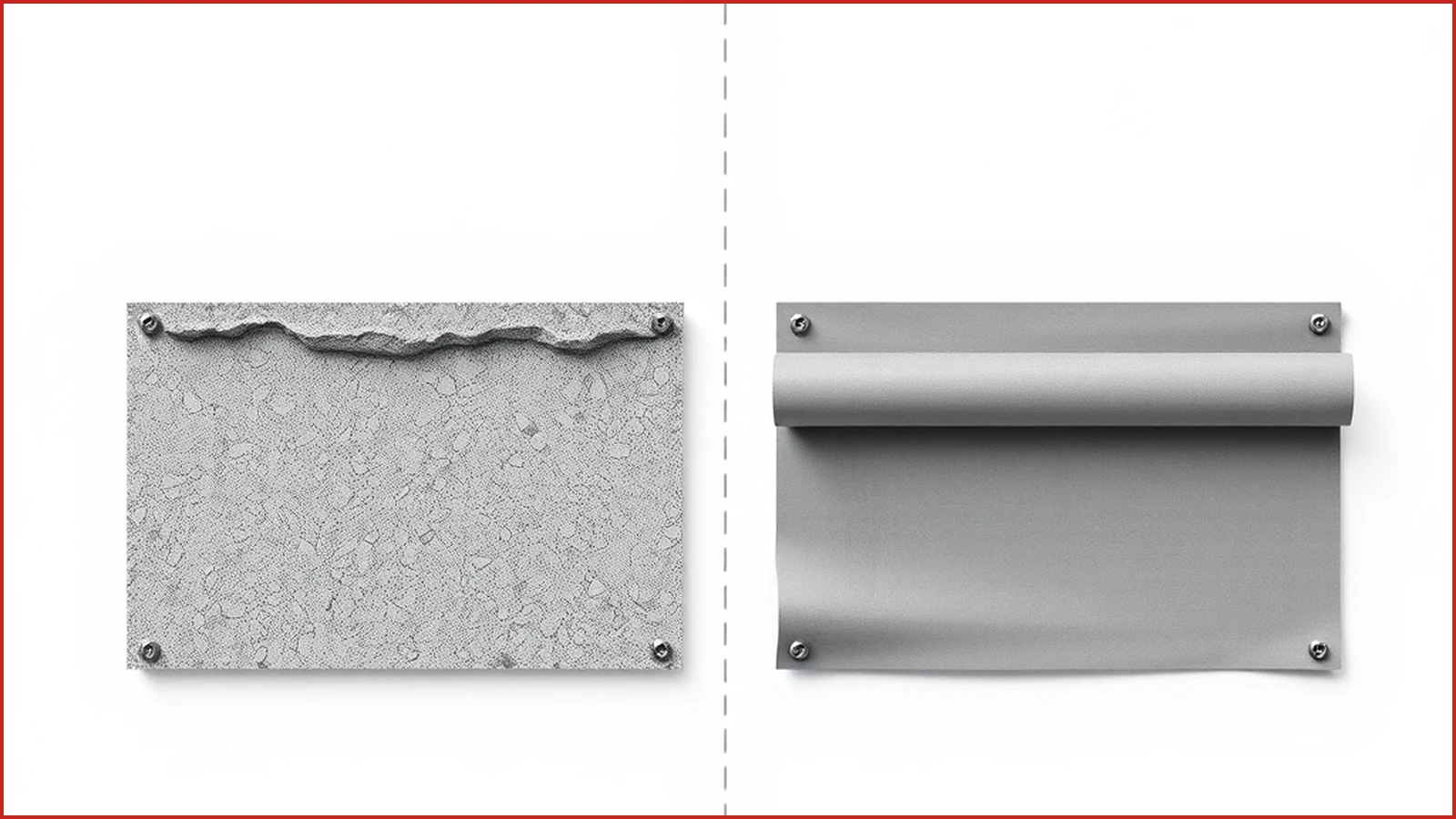
AI illustration · schematic, not a site photo
2026-11-24 · 3 min read · ALEX
Crystalline vs Membrane Waterproofing: Which for a Basement
Crystalline waterproofing reacts inside concrete; a membrane sits on it. The right choice for a basement depends on pressure, movement and access.
Crystalline waterproofing and membrane waterproofing are often presented as rivals, but they work in different places.
Crystalline material penetrates a cementitious substrate and reacts inside it to form insoluble crystals.
A membrane is a continuous layer placed on the surface, either as sheet material or as a liquid-applied film.
For a basement, the choice turns on water pressure, movement and whether you can reach the outside face.
Crystalline penetration waterproofing is specified for basements, water tanks, tunnels and other underground structures.
Because the reaction happens inside the substrate, it can be used against negative-side pressure, which is the technical way of saying water pushing from the outside while you apply from the inside.
That makes it useful for an existing basement where excavation is not an option.
Its limits are just as important: it needs sound, damp, clean concrete to penetrate, it does not bridge a moving structural crack, and it cannot compensate for a construction joint that keeps opening.
A membrane works by forming a barrier rather than changing the substrate.
HDPE and TPO sheets, polyurethane liquid membranes, rubberised bitumen coatings and similar systems are chosen when a continuous layer with defined thickness is needed, especially where some movement is expected or where the structure is being built new and the external face is accessible.
The trade-offs are surface preparation, detailing at corners, joints and penetrations, and protection of the membrane before backfill.
An internal membrane can be applied from the inside, but it must be detailed so trapped water does not find a route around it.
So which for a basement? If it is a new build and the outside face is reachable, an external membrane with proper protection is usually the primary defence, and a crystalline product can add tolerance at the concrete itself.
If it is a retrofit with water coming through the inside face, a crystalline slurry or a negative-side slurry is often the workable answer, provided the concrete is suitable and the cracks are static.
If the crack is moving, neither a crystalline treatment nor a rigid membrane alone will hold: the movement has to be dealt with first.
The question "can crystalline waterproofing be applied from inside" therefore has a qualified yes.
It can, and negative-side suitability is exactly why it is specified for that situation.
The qualification is that inside application treats symptoms unless the water path and the structural condition have been understood.
We ask for the construction detail, the crack pattern, the substrate condition and the side the water is pushing from before recommending a grade.
In our range, both families are represented: Crystalline Penetration Waterproofing, HDPE / TPO Synthetic Polymer Waterproof Membrane, Polyurethane Waterproof Membrane Coating and Negative-Side Waterproof Slurry.
We do not present one as universally better.
At acceptance, record the substrate preparation, the application side, the thickness applied and a retained sample from the delivered batch; then check the wetted area after the specified cure, not immediately after application.
Crystalline and membrane systems differ in where the waterproofing actually lives.
A crystalline treatment works inside the concrete and is more suitable than a sheet membrane for negative-side pressure, whereas a membrane provides a measurable external layer that can bridge movement.
Crystalline material is lower-risk where excavation is impossible, while a membrane is the higher-confidence choice where the outside face can be reached and protected.
Use crystalline instead of a bonded membrane on a retrofit inside face; use a membrane instead of relying on crystals across a moving joint. · waterproof coating systems · the matching product grade · specification guide for waterproof coating systems · field notes on waterproof coating systems · full product catalogue · request a free paint sample · specification guide for waterproof coating systems.

Reference specification for the linked grade
· Values shown are typical reference figures for this product type per applicable national/industry standards — not our own measured test figures. The test report of the exact batch/model prevails before contract.
- Theoretical coverage
- 1.2–1.5 kg/m² per coat
Related reading
Ready to Test Our Products?
Tell us your market and target specification. We will supply samples and a tailored quotation promptly.